
Cherokee County Owner Record
The assessor portal puts "Property Owner" and "Owner name" at the top of its search screen. Once a likely parcel surfaces, read the owner name. Read it beside the parcel identifiers, not in isolation. The portal labels confirmed there should be treated as the known set. The tax-history result adds a second record. It keeps owner and taxpayer in separate fields. Open the official Cherokee County assessor portal to run an owner-of-record search and review the parcel criteria.
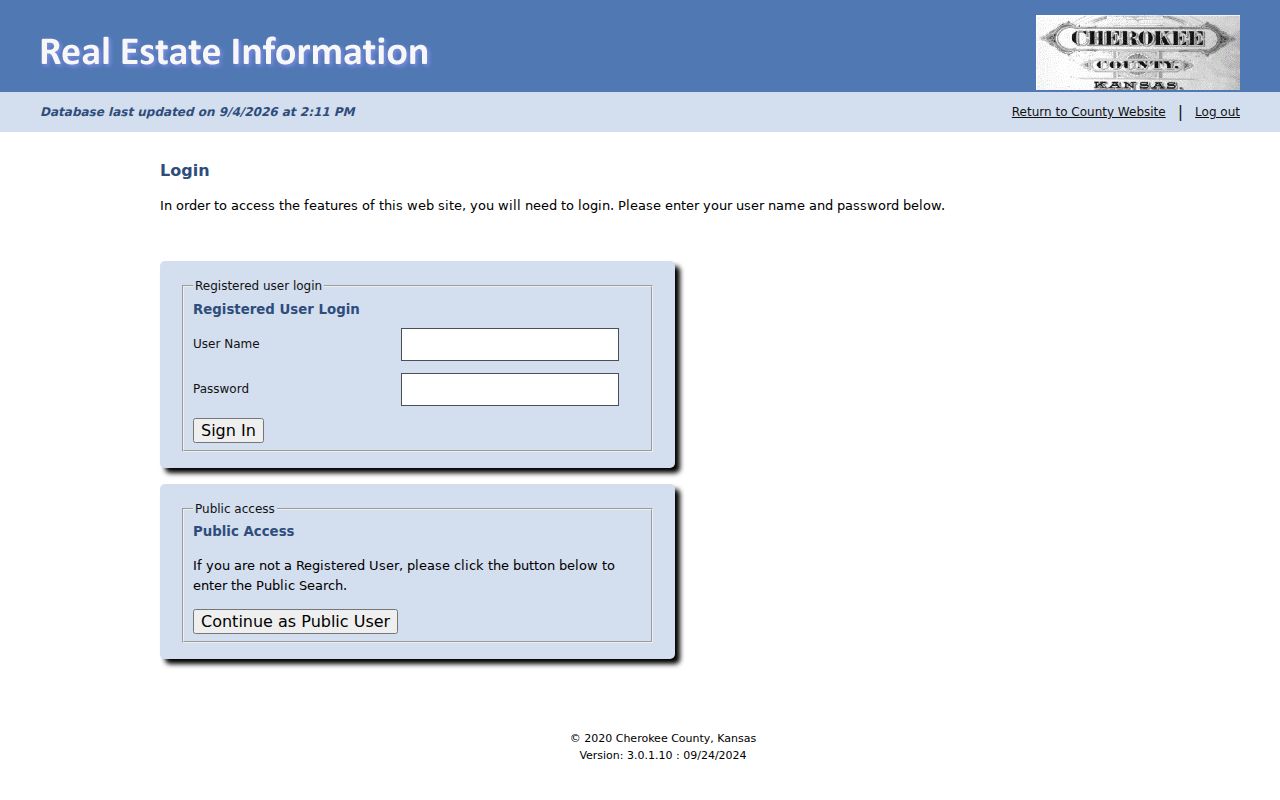
The official assessor portal view shows the public starting point for an owner lookup. After a recent conveyance, the newest recorded deed remains the more current check.
| Owner Name | The owner label on the current county result |
|---|---|
| Owner ID | The tax system key associated with that owner |
| Taxpayer Name and ID | A separate payment or notice role that may differ |
| Situs Address | The location of the parcel itself |
| CAMA and Tax ID | Keys used to confirm the same tract across systems |
| Location | Section, township, range, and tract context |
A record card is a snapshot, not a title certificate. It names the party carried on the roll at the moment it was pulled. It proves nothing about who lives on the land, and a mailing address often points elsewhere because owners receive notices away from the property itself.
Time-Stamp Cherokee Current Owners
The assessor portal displays a database update stamp. That stamp reflects the database state on its date. It is not a guarantee that every newly recorded deed has reached the roll. Cherokee County publishes no standard lag between recording and an owner update. Write down the check date and the displayed update date. If the transfer is recent, open the recorder index next. A current owner answer gains weight when it names the source checked and when. Avoid saving "today" in notes unless the date travels with it. Portals refresh on their own cycles.
Cherokee Owner Versus Taxpayer
The county tax-history record labels Owner ID and Owner Name apart from Taxpayer ID and Taxpayer Name. One sample may show the same party in both roles. The labels still are not interchangeable. A fiduciary, payment contact, or other tax role can differ from the owner tied to the parcel.
Read the label. Use Owner Name for the roll’s owner and treat Taxpayer Name as a separate role unless deed evidence connects them.
Then match the situs, CAMA number, tax identification, and location. These cross-checks cut same-name errors and keep the owner answer tied to one Cherokee County parcel.
Match the Cherokee County Parcel
A correct name on the wrong tract is still a wrong answer. Compare the site address against the detailed street fields. Then check subdivision, lot and block, or section, township, and range. The CAMA components shared by the assessor and tax systems act as another cross-system key. City property may carry historic addition names and city suffixes within the county vocabulary. Rural land often has no useful street history. The Sixth Principal Meridian grid matters most there. The legal description on the newest deed should describe the same tract. If it does not, resolve the parcel identity before trusting any owner name.
Confirm Cherokee County Current Ownership
Use the recorder whenever a conveyance is recent or a mismatch appears. CIC eSearch allows searches by grantor, grantee, document number, legal description, and film or page. The task stays narrow: find the newest instrument that vests the identified parcel, then look for any later instrument that changes or corrects it.
- Read the current owner label and parcel keys in Cherokee County Property Search.
- Search that owner as grantee in CIC eSearch and match the legal description.
- Record the date, deed type, instrument number or book and page, and parties.
- Look for a later corrective, quitclaim, death, estate, or trust instrument.
- Owner of record
- The party shown as owner in the county record at the time checked.
- Vesting
- How a deed places the stated interest in a person, trust, or entity.
- Registered agent
- The state-listed contact for a business, not proof that the agent owns its land.
Check New Cherokee County Deeds
The Register of Deeds is the better source when a conveyance was just recorded. Search the grantee spelling from the deed along with the parcel's legal description. A quitclaim transfers whatever interest the grantor holds. It does not by itself guarantee clear title. A corrective deed may adjust descriptive or party details without representing a new market sale. Also check for later releases or related instruments when they bear on the question. The recorder records and indexes documents. It cannot certify good or clear title. It cannot act as an attorney or serve as a title company. For legal reliance, a current owner search is a starting record check. It is not the final professional opinion.
Interpret Cherokee Entity Owners
A current owner may appear as an LLC, corporation, trust, or estate. Preserve the name exactly as indexed and try common punctuation and suffix variants. A trustee can sign in a stated capacity. An executor or administrator may act for an estate. The recorded instrument and probate record explain the role better than the name alone. For a Kansas business, the Secretary of State search supports lookups by business name, business ID, and resident agent. The business record can identify the entity named as grantee. Its status or agent listing is not a Cherokee County title record, so tie it back to the deed and legal description.
Compare Cherokee GIS Owner Labels
Integrity GIS adds Quick Ref and owner labels right on the map. That context helps confirm the parcel you selected matches the assessor result. Treat it as a quick reference, nothing more. Cherokee County GIS layers change often through parcel splits, tax-unit alignment, and road rights-of-way updates. The recorder, meanwhile, maintains the legal instruments behind those labels.
A mismatched name is not evidence of fraud. Compare parcel keys. Check the dates on each layer. Then rely on the latest recorded deed. Different update cycles explain most conflicts. That habit keeps current owner analysis anchored in property records instead of guesswork.
Protect Cherokee Owner Addresses
Kansas Safe at Home gives eligible victims a substitute legal address. The address works for state and local agencies, plus mail forwarding. A Cherokee County property record may therefore display a substitute address. Treat it as valid. It is not a bad field or a clue to a protected location.
KORA also bars using public lists of names and addresses for sales offers. Keep owner of record research tied to a real property question. Do not post birth dates, family details, or sensitive identifiers. A mailing address in the tax roll never proves where someone actually lives.
Limits on Cherokee Current Owners
An assessor name plus the newest deed can support a careful present-tense conclusion. They do not prove occupancy. They do not settle every possible interest, and they never replace a title search. The owner mailing address often differs from the situs. Routine reasons include business ownership or remote mailing. Limit any contact to a lawful property purpose.
Property records may still conflict after logging each source and date. The Register of Deeds can then explain access and indexing. Staff cannot give legal advice. Does the result need to support a transaction, a dispute, or a clear-title conclusion? A title professional or attorney is the right next step. For the broader address-to-owner method, see the Cherokee County property owner guide.
An offline check deserves the same precision as portal work. Bring the situs, CAMA number, tax identification, and legal description. Bring the name exactly as the county result shows it. Ask for the newest relevant recorded instrument. Skip a broad search tied to a person. The Register of Deeds sits at 110 W Maple in Columbus. Office hours run 8 a.m. to 5 p.m. Recording hours run 8 a.m. to 3:30 p.m. Staff can explain access, book prefixes, copies, and certification. They cannot decide the legal effect of competing instruments.
Lawful use. Current owner records support parcel research; never use them to stalk, harass, target, or bypass a protected address.