
Find Who Owns Cherokee Property
A good owner search chases the parcel. Begin with a street address in the Cherokee County assessor portal. If nothing comes back, try part of the owner name or the detailed street fields. The goal is a parcel identity. A similar-sounding name alone proves little. Once the record opens, copy the owner spelling, situs address, CAMA components, tax identification, subdivision lot and block, or the section, township, and range.
- Search the Cherokee County Property Search by full address or a partial owner name.
- Match the situs and legal-description fields to the land in question.
- Search CIC Register of Deeds eSearch for the newest deed to that grantee.
- Check later corrective, quitclaim, estate, or trust instruments before drawing a conclusion.
This route answers who owns this property by pairing assessment data with recorded instruments. The assessor gives the quick lead. The deed gives firmer confirmation for a recent transfer, and noting the date of each check helps because the two systems refresh on different schedules.
Start With Cherokee County Situs
The situs is simply where the parcel sits. It may not match the owner's mailing address. A normalized street number, direction, name, suffix, city label, and ZIP improves the odds of a hit. A ZIP alone proves neither city limits nor identity. Treat the address as a route to the parcel card, nothing more.
Rural land calls for different tools. For a rural Cherokee County property, the legal-land fields of section, township, and range often work better. The county systems also expose the component CAMA pattern. In a platted city addition, subdivision, lot, and block are stronger checks. These fields keep the search honest. They guard against a person with the same name. They also guard against a second parcel on a similar road.
Read Cherokee County Owner Fields
The assessor search labels its main name input "Property Owner" and "Owner name," and any portion of the name works. The labels matter. The tax-history result runs on Owner ID, Owner Name, Taxpayer ID, and Taxpayer Name. Owner and taxpayer can differ in role. Turn to the official Cherokee County assessor search first.
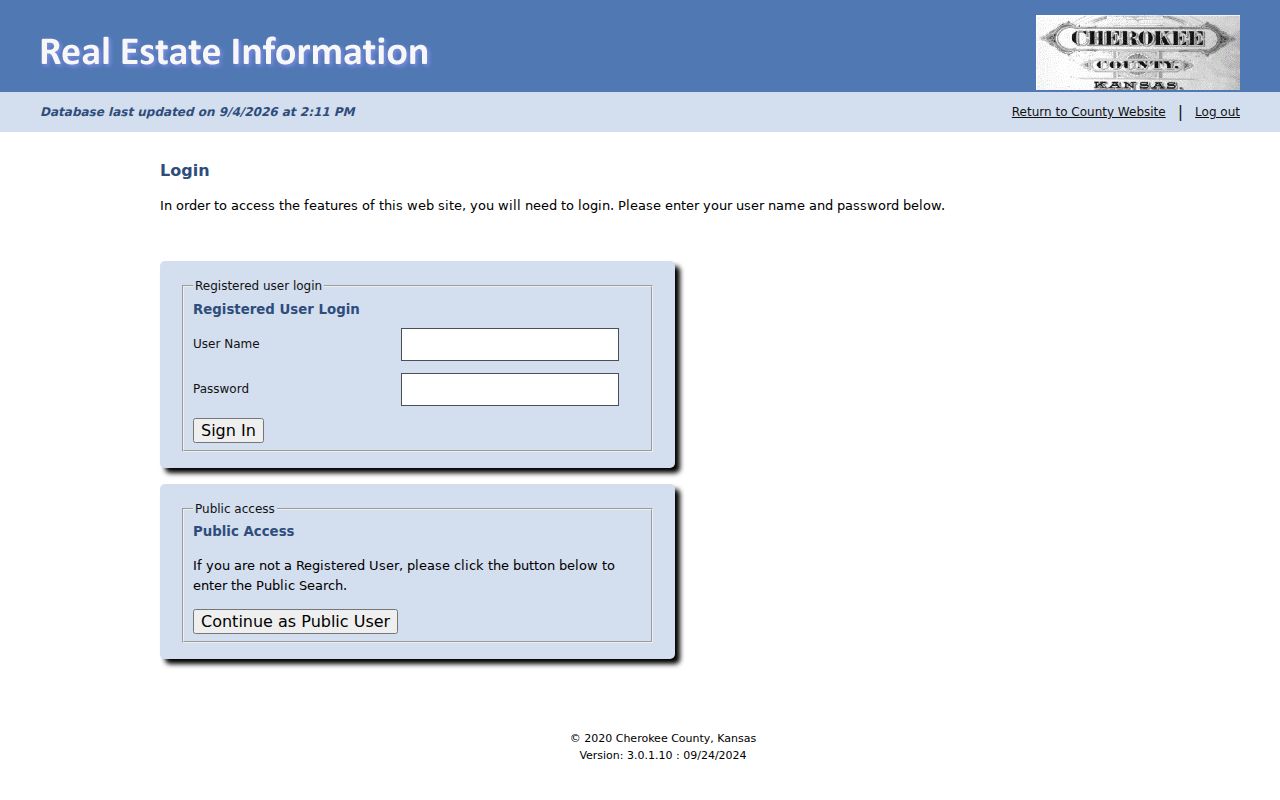
The official assessor page shows its public entry fields. A parcel identified here can then be traced through the latest deed for recorded ownership.
Key distinction. A taxpayer, fiduciary, or payment contact is not automatically the owner of record shown by the deed.
Then confirm the match. Check the situs, CAMA number, and tax identification. Location fields matter too, because they tie a Cherokee County property owner name to a particular tract instead of a free-floating personal detail.
Confirm Cherokee County Ownership
A fresh deed can reach the recorder before the assessment roll catches up. The county sets no fixed day count. So no reliable owner search should promise a timeline in Cherokee County. Search the current name as grantee in CIC eSearch. Compare the deed's legal description with the parcel result. Record the recording date, instrument number or book and page, deed type, grantor, grantee, and any prior-instrument reference.
Search for later instruments as well. A corrective deed may repair a name or description. A quitclaim may transfer only the grantor's claim, and an estate or trust instrument may explain new vesting. The Register of Deeds records all of these, but cannot certify good or clear title or act as a title company.
Decode Cherokee Owner Names
Who appears as owner? An individual, trust, estate, corporation, or limited liability company can all hold title in Cherokee County. Vary the search: punctuation, suffix, trust, estate, and entity variants all belong in the recorder query. The role must come from the instrument itself. A name in a mortgage, lien, easement, or power of attorney is not necessarily the fee owner.
A business grantee deserves one more step. The Kansas Secretary of State Business Entity Search can be searched by business name, state business ID, or current resident-agent name. A Contains search with a partial keyword helps. The result identifies the entity. It does not replace the Cherokee County deed as proof tied to the land.
Where Cherokee Owner Evidence Lives
Several public records speak to the owner question. They do not carry equal weight, so use each for its stated role and compare parcel identifiers before joining any results.
| Source | Owner Info It Gives | Access |
|---|---|---|
| Assessor and tax roll | Listed owner, taxpayer, situs, and parcel keys | Public county portals |
| Recorder deed index | Grantee on the latest recorded conveyance | CIC eSearch or county counter |
| Secretary of State | Kansas entity and resident-agent record | State business search |
| Integrity GIS | Map-based Quick Ref and Owner context | Public map viewer |
The person occupying a house may rent it, manage it, or share it with an owner. Owners, in turn, may get their mail somewhere else. No source here confirms who is physically present. The real question is ownership of a parcel, and the legal description keeps the search pointed at that question.
Match the Cherokee Legal Description
Street names change. Mailing cities cross boundaries. One person may hold several tracts. Against all that drift, the legal description is the stable bridge, whether it reads as addition, lot, and block in town or as section, township, and range on the Sixth Principal Meridian grid. The assessor's component fields and tax CAMA pattern supply one more parcel-specific key.
- Owner of record
- The party shown as owner in the public land or assessment record at the time checked.
- Vesting
- The way an instrument places title in a person, trust, or entity.
- Grantee
- The party receiving the stated interest in a deed.
- Situs
- The physical location of the parcel, which can differ from the tax mailing address.
Use these terms with care. Even a perfect match cannot guarantee that no unindexed claim, probate issue, or later filing exists.
Resolve Cherokee Record Mismatches
Start with a simple list when the assessor, tax roll, GIS label, and deed disagree. Write each name, its role, its source, and the date you checked. Most mismatches trace to a new deed that has not reached the roll. Separate owner and taxpayer fields explain others. A corrected legal description can also explain a split result. Map, tax, and deed records follow different maintenance schedules too. Gaps appear for ordinary reasons because of that.
Looks can deceive. The assessor portal may show a fresh database update stamp. That stamp never promises every recorded deed has posted to the roll. For a recent sale, the newest recorded conveyance is the better next check. If dates or roles stay murky, ask the Register of Deeds about the indexed instruments. Staff cannot give legal advice, though they can explain what the index shows.
Watch Cherokee Property Activity
The Cherokee County Register of Deeds posts a Property Activity Alert form on its site. A property owner can file it. They then receive notice of activity tied to a property or a name. The county's own description backs that use. The form's exact fields, delivery method, fee, trigger, and cancellation terms should be confirmed on the current document.
An alert cannot block a filing. It is no title guarantee either. When an instrument looks suspicious, verify its document number, date, parties, notary, and legal description. Look for a later correction or release as well. Then contact the recorder, a title professional, an attorney, or law enforcement as the facts warrant.
Limits of Cherokee Owner Lookups
Who owns this property is a narrower question than it sounds. It is not the same as who lives there or who manages it. It also does not settle whether title is clear. Property records can show a listed owner, a grantee, a taxpayer, and a map label. They cannot prove occupancy or guarantee that no claims exist. They do not replace an abstract and a professional title examination.
When the online route stalls, take the parcel keys to the right office. The Register of Deeds counter sits at 110 W Maple in Columbus. Staff there can explain the older index and book conventions. The county accepts recorder questions by phone, mail, fax, email, and in person. The FAQ notes an in-person visit often works better for research. A narrow request should name the parcel. It should also give the legal description, the record type, and a date range. Kansas open-records procedures offer a fallback for an existing non-exempt record. They do not require staff to build a new ownership report. Nor must they field a broad research question.
Kansas Safe at Home gives eligible victims a substitute legal address with mail forwarding. That address is a safeguard, not an error to reverse. KORA also limits using public lists of names and addresses for sales offers. Keep the search parcel-based. Avoid bulk personal lists, and never reproduce sensitive identifiers.
Lawful use. Cherokee County owner records support land research and due diligence; they must not be used to stalk, harass, target, or bypass address protections.