
Inside Cherokee County Tax Records
One tax bill rests on several linked county records. Each office owns a different piece. The Cherokee County Appraiser estimates market value and sets the property class. The County Clerk then handles roll administration, from mill levies to special assessments. Collecting the money falls to the Cherokee County Treasurer. That office issues statements, records payments, and tracks delinquent real estate taxes. Knowing who does what matters here. It keeps a paid tax bill from being confused with proof that an appraisal is right.
| Tax field | Meaning in the record | County source |
|---|---|---|
| Appraised value | Annual estimate of fair market value as of January 1 | Appraiser |
| Assessed value | Appraised or economic-use value multiplied by the class rate | Appraiser and tax roll |
| Statement and tax year | The bill identity and year charged | Treasurer |
| Half payments | First and second half due and paid amounts | Treasurer tax history |
| Specials and balance | Special assessment description, payoff field, and total shown due | Treasurer tax history |
The recorded sale price stands apart from all of this. A deed reflects a single transfer, while appraised value is an annual estimate and assessed value is the base levies apply to. For a fuller comparison of these figures, see the Cherokee County property value explanation.
Search Cherokee County Property Tax
The public Cherokee County Tax Information Search opens without a login. Pick Real Estate, labeled RL, for land and buildings. A broad owner search works best with just the last name. Address and parcel fields then narrow the results down. The form also separates current owner from taxpayer. That distinction helps when the two roles differ.
| Search control | Input | Best use |
|---|---|---|
| Tax Type | RL, PP, OL, GS, TK, MN, or SA | Choose RL for real estate |
| CAMA Number | Map, Sec, Sht, Qtr, Blk, Pre, Suf, Own | Exact parcel match |
| Name Match Type | Current Owner, Taxpayer, or Both | Separate ownership and billing roles |
| Tax Years | Starting and ending year | Limit the payment-history span |
| Balance filters | Current taxes or taxes due | Find current or delinquent statements |
| Property criteria | Address, ZIP, subdivision, lot, block, section, township, range | Search when an ID is unknown |
Keep every leading zero in the CAMA components. The portal also accepts Tax Identification, Owner or Taxpayer Identification, lease name, and Quick Ref. It publishes no earliest coverage year. So a gap on an old parcel points to a Treasurer or written-record request rather than a missing record. Open the official tax search to confirm current form labels before relying on them.
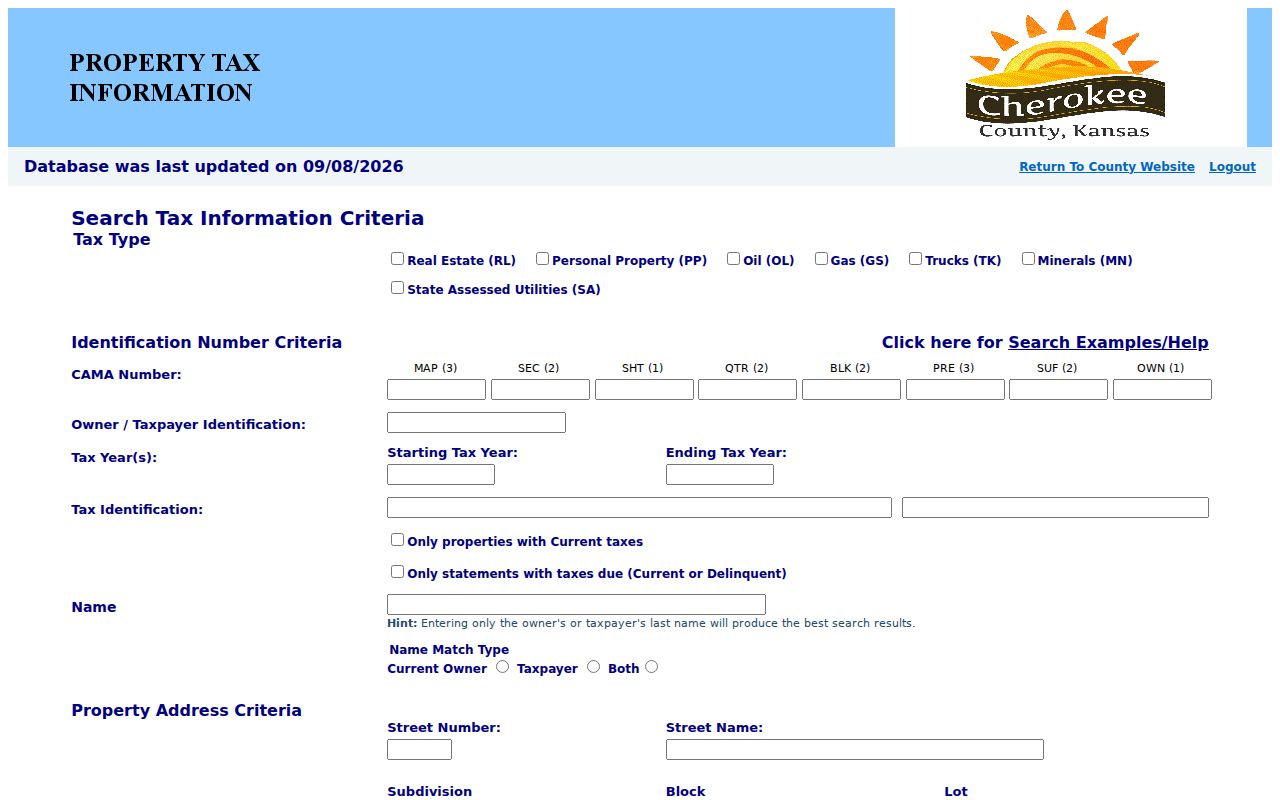
The image offers a quick visual check of the county search entry. The live portal remains the source for current options and balances.
Retrieve a Cherokee County Tax Bill
Start with the strongest identifier you have. An address is convenient. The CAMA or Tax Identification is less likely to confuse parcels sharing similar street names. This short route moves you from the search form to a usable Cherokee County property tax record.
- Select Real Estate and enter the address, owner name, or full parcel identifier.
- Confirm the situs address, CAMA Number, legal location, and owner or taxpayer name.
- Open the tax year and read its statement, half-payment, paid, and total-due columns.
- Contact the Treasurer for a payoff because displayed totals exclude some interest, penalties, and fees.
- Assessed value
- The taxable base after the class rate is applied.
- Mill levy
- The tax rate applied to assessed value.
- Special assessment
- A separate charge tied to a public improvement or service.
- Tax lien
- A claim created by unpaid property tax.
The state Kansas property-tax gateway offers another online route. Payoff and protest questions stay with the Treasurer. Phone, mail, email, courthouse service, and a focused KORA request all work when the portal cannot resolve the parcel.
Cherokee County Tax History Rows
One Cherokee County real-estate result displayed tax history running from 2005 through 2024. That sample shows the system can return older years. It does not set a countywide start date. Each row listed statement and line numbers, specials, first- and second-half amounts due, and total due. Both halves paid appeared there too. The result kept Owner ID and Taxpayer ID as separate fields. They matched here, but another parcel may show different names. Situs address, section, township, range, and tract appear alongside the IDs. CAMA Number and Tax Identification confirm the right land record is open. The source tax-history result shows the full layout.
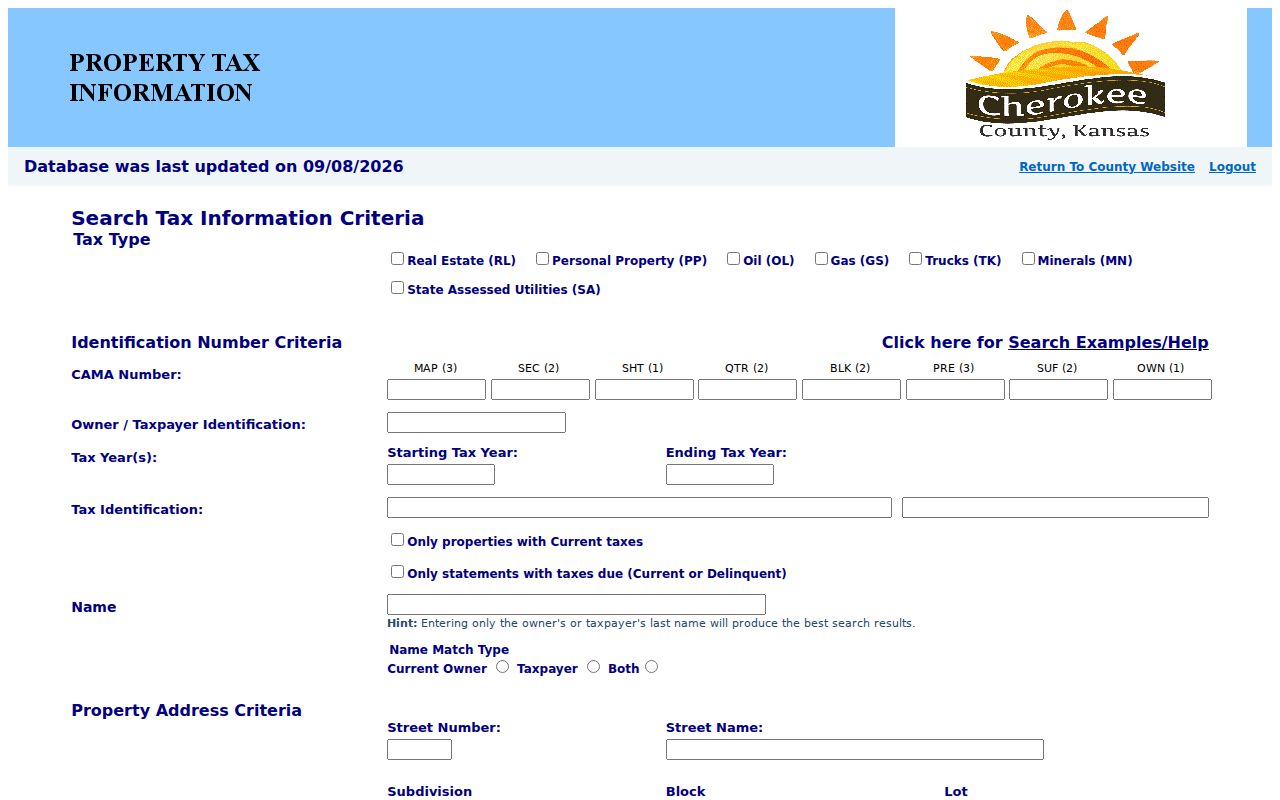
The columns show why each yearly payment row must be read with its parcel identity. The portal's caution about added payoff costs matters too.
Cherokee County Assessment Calendar
Kansas sets real property values once a year, using January 1 as the valuation date. From there, Cherokee County follows a strict spring schedule. Change of Value Notices go out by March 1, and April 1 is the deadline to request an informal review of a parcel's value or classification. Informal conferences wrap up by May 15. The state then requires a final determination by May 20, certification of values in June, and a later handoff of the tax roll from the Clerk to the Treasurer.
That sequence matters for any property owner. A value fight happens in spring. A bill dispute belongs to fall. The Kansas real-property calendar lays out the statewide timeline, though the county notice gives the dates tied to your parcel number. Keep both the envelope and the notice, since the appeal clock starts at mailing.
Note: Read the current notice each year, because portal timestamps and calendar dates mark different stages of the tax record.
Contest Cherokee County Assessed Value
An owner may challenge value or classification after the Change of Value Notice arrives. Kansas law allows an appeal within 30 days of mailing, and Cherokee County identifies April 1 for its informal real-property appeal cycle. Bring facts tied to the parcel. Corrected building details, land use, property class, recent qualified sales, or unequal treatment of comparable properties all count. If the informal decision still seems wrong, the Kansas Board of Tax Appeals route generally has its own 30-day window. A separate payment-under-protest path begins when tax is paid. The county Payment Under Protest form asks for claimed value or proper classification, facts and law, payment choice, signature, and county calculation fields.
Protect the deadline. File within the period on the current notice; an unsigned protest form is invalid, and escrow-paid taxes have a separate January 31 route.
Cherokee County Delinquent Property Tax
Real-estate tax in Cherokee County splits into two halves. The first half is due December 20. Pay late but before May 10 and interest accrues. Miss May 10 and the full tax, plus interest, comes due at once. Let three years go unpaid and the county can foreclose, a sale process the Treasurer warns may take a year or more.
Cherokee County publishes current-year delinquent real-estate taxes in August for three straight weeks under K.S.A. 79-2301 through 79-2323a. A portal balance is never a formal payoff. Interest, penalties, and fees may be missing from the total, and the specials payoff shown covers only the current year. For a true delinquent amount on any parcel, call the Treasurer's delinquent-tax line at 620-429-3848 and get the figure straight from the source before relying on any property tax records display.
Cherokee County's Five-Percent Trend
Cherokee County's January 2026 market-study notice reported an overall five percent inflationary trend. It covered residential, commercial, and vacant land. Treat that as a countywide signal, not a guarantee. It does not promise every parcel gained five percent. Physical changes and corrected legal descriptions can push one property tax record in a different direction. So can neighborhood sales, appraisal adjustments, and equalization.
The distinction matters when comparing years. First confirm the property class and characteristics stayed the same. Then line up the appraised and assessed figures for the same assessment year. A sale, renovation, split, or corrected square footage can explain a swing. The broad trend figure never will.
Cherokee County Improvement Rebate Records
Cherokee County links a 2023-2027 Neighborhood Revitalization Plan application for owners seeking an improvement rebate. The form asks for the owner of record, mailing address, school district, and parcel ID. It also requires a building permit, property address, legal description, proposed use, and planned improvements. The plan material lists a $25 filing fee and describes filing within 60 days. Verify current deadlines and participation rules before acting.
This rebate rides on qualifying improvements and county approval. It is not a broad exemption. Nor should anyone infer eligibility from a lower tax bill alone. The amended NRP application is the right place to confirm the process. It also lists the parcel details the county requires.
Cherokee County Tax Record Checks
A Cherokee County property search is strongest when CAMA, tax identification, situs, owner, taxpayer, and legal location all point to one parcel. The history separates first-half and second-half due and paid fields, statement and warrant references, specials, and year links. It also warns that displayed totals omit interest, penalties, and fees. For a current delinquent payoff, contact the Cherokee County Treasurer at 620-429-3848 rather than treating the portal total as final.
Keep the assessment year apart from the payment year. The Appraiser sets value and class. The County Clerk runs the tax roll and levy. The Treasurer bills and collects. A mismatch between these deed and tax records may reflect timing rather than error, so note each source and its date before requesting any correction to the property records.