
Cherokee County Deed Types
Every real-estate instrument in Cherokee County gets its official record at the Register of Deeds. The Cherokee County Register of Deeds handles deeds, mortgages, oil and gas leases, and plats. The plats cover additions within county cities. The office also takes in tax liens. UCC fixture filings, powers of attorney, and similar instruments come in as well. Keep one limit in mind, though. The deed records reflect only what the office accepted and indexed. They are not a legal opinion on title quality.
| Deed Type | What It Does | Common Use |
|---|---|---|
| Warranty deed | Conveys the described interest with warranty language | Ordinary transfer |
| Quitclaim deed | Conveys or releases whatever claim the grantor has | Interest release or title cleanup |
| Corrective deed | Repairs an error in a prior recorded deed | Name or description correction |
| Estate or trust deed | Transfers through an authorized fiduciary | Estate or trust action |
| Sheriff or tax deed | Records a transfer after a legal process | Foreclosure or tax sale |
Not every instrument transfers land. A mortgage, easement, or lien can bind a parcel while the surface owner stays put. Each release, assignment, or satisfaction needs its own search. Mineral and oil and gas filings matter too.
Cherokee County Deed Search Fields
CIC eSearch is the county's online recorder route. Cherokee County publishes five search keys for it: document number, grantor, grantee, legal description, and film or page. The portal's own dropdowns and image options vary, so work from the live screen rather than any assumption about its layout.
| Search field | Best use | Check next |
|---|---|---|
| Grantor | Party that conveyed an interest | Instrument type and grantee |
| Grantee | Party that received an interest | Land description and prior deed |
| Document number | Known modern reference | Recording date and parties |
| Legal description | One tract across name changes | Subdivision, lot, block, or legal land |
| Film or page | Known book reference | Image and linked index entry |
The portal serves as a public starting point. Coverage depends on the era and the document type, and images tied to Social Security numbers, death certificates, or UCC records stay restricted. The recorder landing page links to the county selection and index.
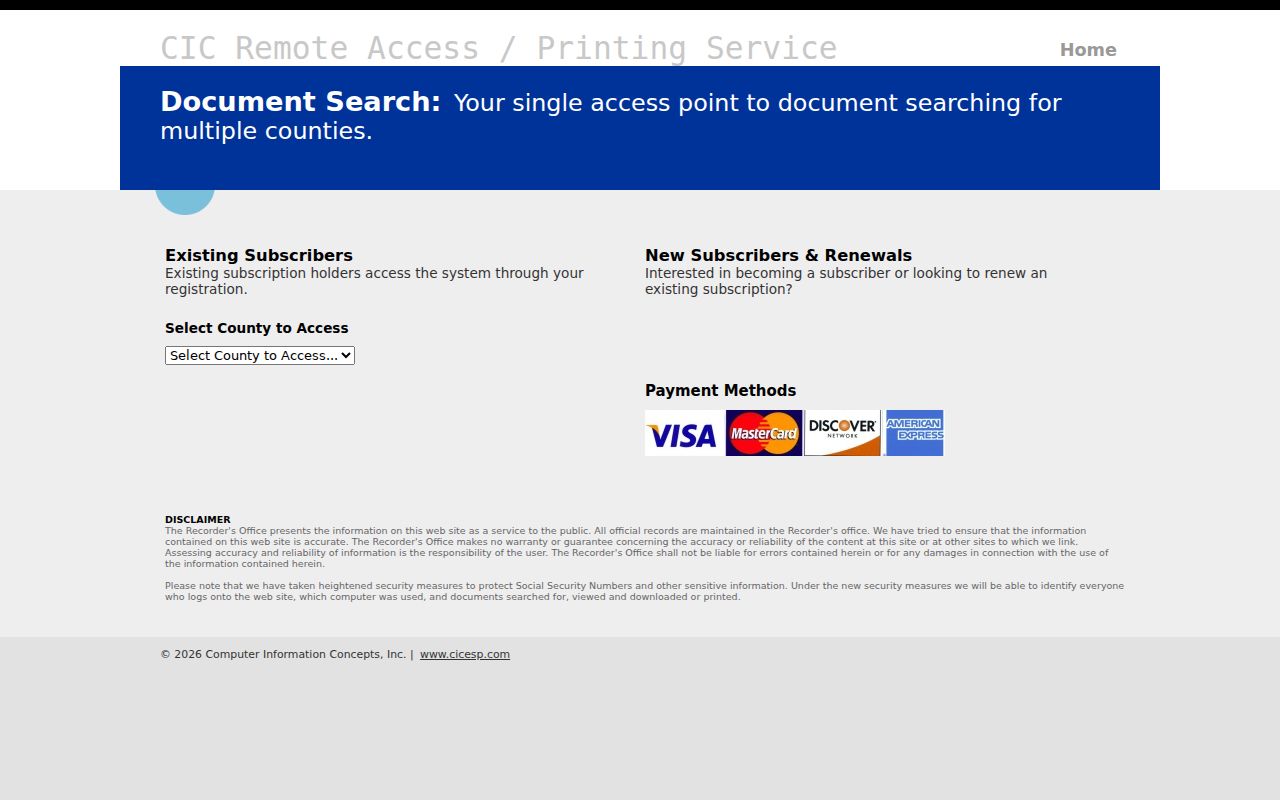
Follow the county's own field rules for every query. Keep the document reference with any copy you download or request.
Cherokee County Recorded Evidence
County guidance draws a sharp line between a signed paper deed and the public record. Only the recorded instrument counts as the county's evidence of a deal. Its index entry or image backs it up. Recording gives notice and protects priority. That is why the office urges prompt filing even without a general deadline. That same line explains a common puzzle. A freshly signed deed will not show up in deed records until someone records it. Search by recording date and party name variants first. If a known instrument still eludes you, ask the office whether it is pending.
Cherokee County Book Prefixes
Book syntax carries real weight here. Indexed names and land descriptions run from deed book D182 to the present. Earlier deed books, A through 225, are requested online with a D prefix. The county instructions write these as Da through D225. Miscellaneous volumes before 103 take an MS prefix. Indexing is described from MS103 back to MS88. Mortgage images reach book 193. For indexed mortgage names and land descriptions, coverage runs from book 270 forward. Books 279 through 193 need the D prefix for images. Treat these as volume rules, not calendar years. When an entry looks doubtful, confirm it with recorder staff.
Cherokee County Grantor-Grantee Chain
The grantor-grantee index stitches each transfer to the one before it. Start with the current owner and parcel description from the assessor. Search that owner as grantee to find the acquisition deed. Then read its grantor, and search that name as an earlier grantee. Record every date, document type, land description, and reference as you go, so parties who share a name never blur together.
- Find the present parcel and exact owner spelling in the assessor or tax roll.
- Search the owner as grantee and match the legal description.
- Read the conveying grantor, recording date, and prior instrument reference.
- Search that grantor as an earlier grantee and repeat.
- Branch out for quitclaims, corrections, estate deeds, mortgages, releases, liens, and plats.
- Grantor
- The party that transfers or releases an interest.
- Grantee
- The party that receives the interest.
- Chain of title
- The linked sequence of recorded transfers for one tract.
- Book and page
- The volume location of an older recorded item.
- Instrument number
- A distinct document reference used in the index.
April 1988 Deed Cutoff
According to the recorder FAQ, nothing before April 1, 1988 sits in the computer system. That date is the practical online cutoff for ordinary deed records. It is not the start of the county archive. For older material, estimate when the transfer likely occurred. Then turn to the alphabetical grantee index. Chase down its book, film, and page references there. Each older book spans roughly six months, the FAQ notes, though the span varies. With no date at all, the County Clerk's Real Estate Records contact can pinpoint the last transfer. It works from an address or legal description at 620-429-9500 ext. 5.
Older deeds still exist. Cherokee County's physical real-estate records date to 1860, while the computer search excludes records before April 1, 1988.
Cherokee County Historic Deed Books
Older Cherokee County deed records survive beyond the courthouse. The Kansas Historical Society Cherokee collection holds Register of Deeds microfilm from 1866 through 1901. The Cherokee County Genealogical-Historical Society adds Cherokee Neutral Land records starting in 1866, plus plat maps, newspapers, and indexed probate and court holdings. These help when an old deed names a town, road, or family that has since changed. The 1902 county atlas doubles as a period map.
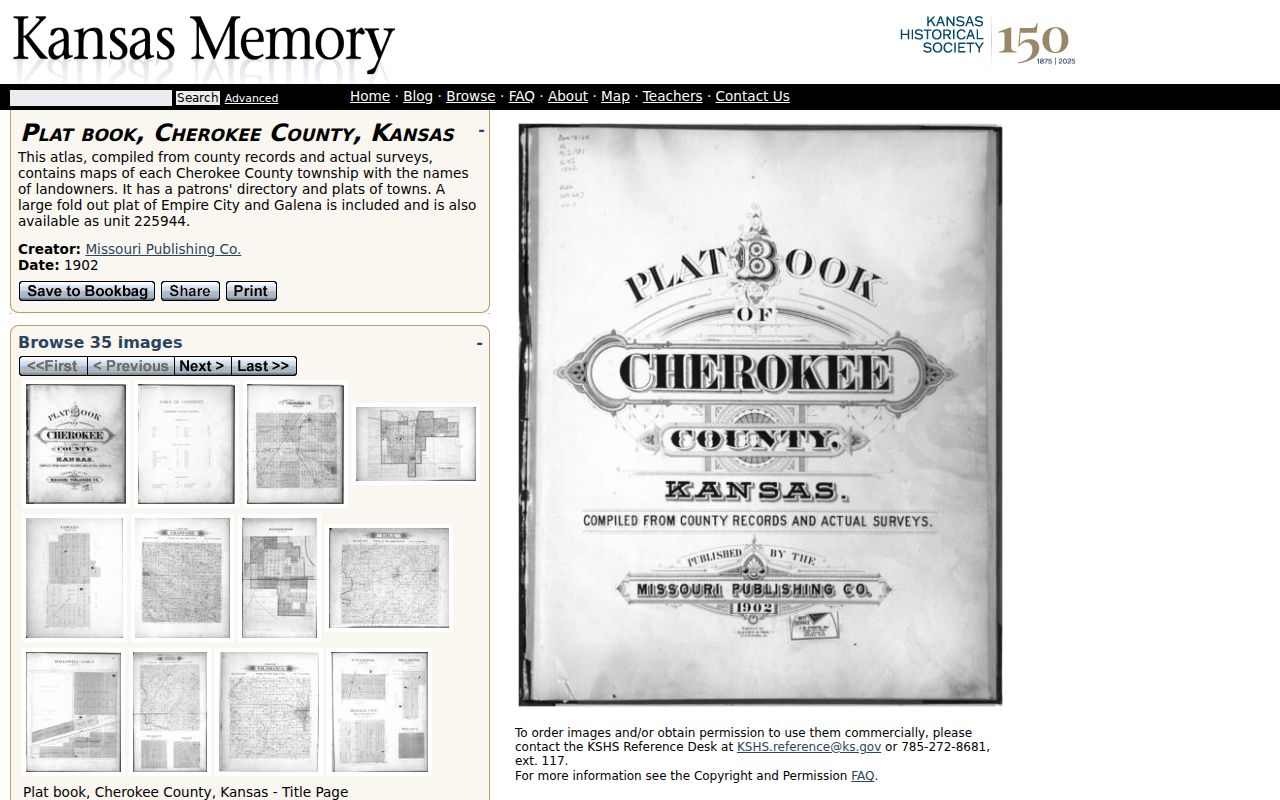
An atlas owner label is just a dated clue. Confirm each chain link against the deed index and volume itself.
Cherokee County Deed Fees
Cherokee County's fee schedule sets $21 for the first page of a deed, mortgage, or other instrument. Each added page or fraction is $17. A certified instrument costs $13. Town plats run $32 per page. A mortgage assignment or release is $20 for the first page plus $4 per additional page, and payment comes due before any work. Other charges on the schedule include $32 for a federal IRS tax-lien notice or release. A certificate of tax-lien search costs $15, and tax-lien copies run $1 per page. UCC originals, amendments, continuations, assignments, releases, and fixture filings up to ten pages cost $15. Each extra page is $1. For mailed requests, ask about payment methods and return postage.
Cherokee County Recording Process
Deeds are accepted for recording between 8 a.m. and 3:30 p.m., even though the Register of Deeds stays open until 5 p.m. on weekdays. Formatting matters. The first page carries a three-inch blank top margin, later pages a one-inch margin, and the county also cites a one-inch bottom margin. Because published guidance varies slightly, confirm the current K.S.A. 28-115 layout before submitting anything.
Once a deed arrives, staff screen it for obvious errors, recordability, and correct fees. The document then receives a barcode plus a document or film-page reference, gets scanned, and is indexed and verified. Plan on roughly two to three business days for the original to come back, per the office FAQ. Any qualifying transfer also requires the Kansas Sales Validation Questionnaire unless an exemption applies.
Cherokee County Deed Access
The county's online eSearch is one access channel. For older volumes or prefix questions, the Register counter at 110 W Maple in Columbus is the strongest route. Staff also respond by phone at 620-429-9500 ext. 7, fax at 620-429-1362, email at karen.johnston@cherokeecounty-ks.gov, and mail at PO Box 228, Columbus, KS 66725.
When a record exists but is not posted online, the county KORA process offers another path. Frame the request with a precise parcel, document type, date range, and delivery format. Mechanics' liens and judicial land cases run through the District Court Clerk instead. Statewide personal-property UCC filings belong to the Kansas SOS, while county fixtures, timber, and as-extracted mineral filings stay with the recorder.
Cherokee County Encumbrance Search
A deed chain by itself is not an encumbrance search. Mortgages need their own query. So do assignments, releases, and satisfactions. Federal and state tax liens need attention too. So do lis pendens, mechanics' liens, easements, restrictive covenants, rights-of-way, oil and gas leases, mineral interests, fixture filings, plats, and corrections. Watch for releases filed later under a different date or party form.
During purchase due diligence, treat public indexes as a lead rather than a clear-title certificate. A qualified title professional can review the full chain and exceptions. That review begins once the relevant instruments are located.
Order Cherokee County Deed Copies
Start with the online image when one exists and an uncertified reference will do. For a plain or certified copy from the custodian, supply the document number or book and page. Also give the party names, legal description, and record date. Say whether certification is needed. Counter staff can clarify image restrictions and calculate the current cost before work begins.
A remote request should state email or mail delivery and ask about prepayment and postage. Avoid asking staff to assemble a title chain. A focused reference cuts ambiguity and search time.
Recorded, not guaranteed. Cherokee County deed records show accepted instruments. They do not prove that no unrecorded interest exists, certify clear title, or replace legal advice.